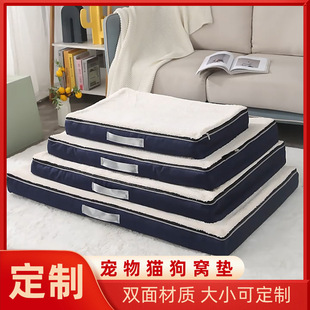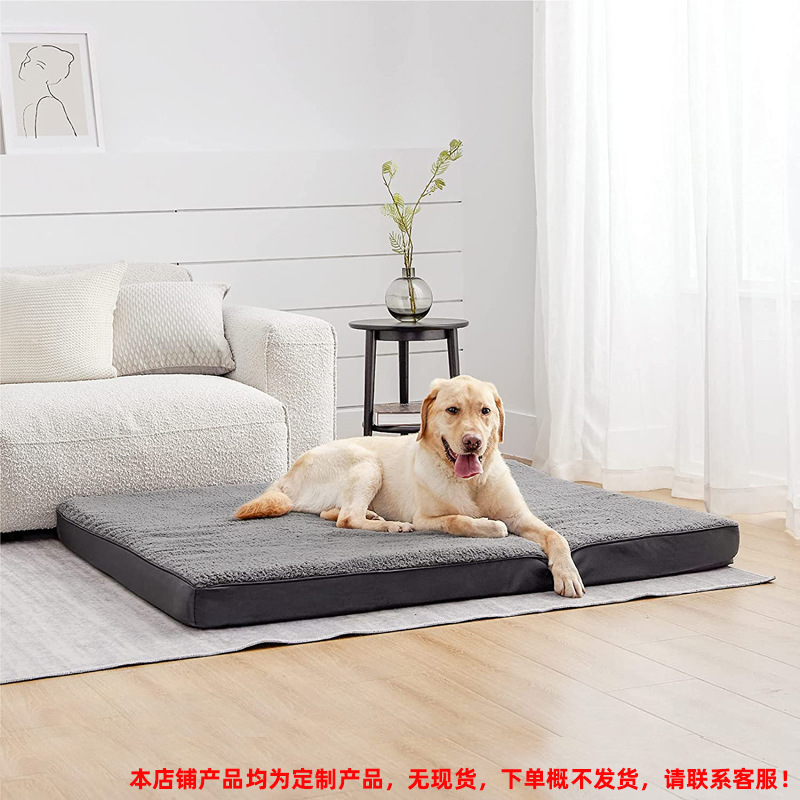
Your pet bed manufacturer is the most critical partner in your supply chain. The right factory delivers consistent quality, hits deadlines, scales with your growth, and protects your brand reputation. The wrong one causes returns, delays, customer complaints, and ultimately brand damage that takes years to repair.
After producing pet beds for brands in 30+ countries, we have seen what separates successful sourcing from costly mistakes. This guide gives you 8 specific, actionable quality checkpoints — not vague advice like "check their quality," but concrete things to measure, test, and verify before placing your first order.
Checkpoint 1: Factory Scale and Capacity Match
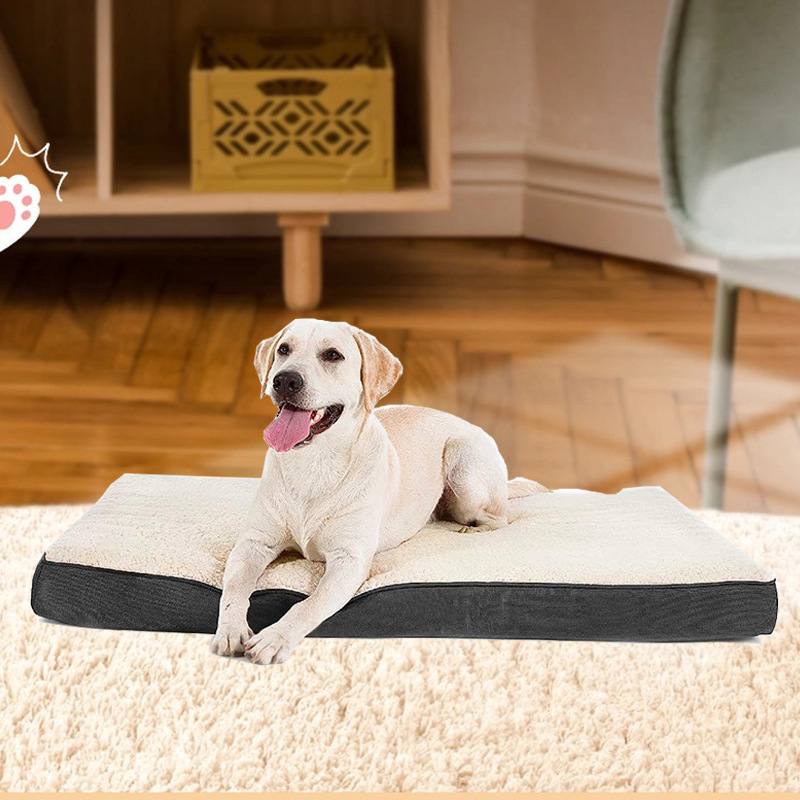
Factory size must match your order volume — not too big, not too small.
Why it matters: A factory producing 100,000 pet beds/month will deprioritize your 500-unit order, resulting in delayed shipments and minimal quality attention. Conversely, a 10-person workshop cannot scale when your brand grows from 1,000 to 10,000 units/month.
What to verify:
- Number of sewing machines: Each industrial sewing machine produces approximately 30-50 pet beds per day. A factory with 60+ machines (like Feitu Pet) can produce 1,800-3,000 units daily.
- Production lines: Separate lines for different product categories (beds, car seats, covers) indicate organization and specialization. Factories running everything on one line are more likely to have cross-contamination of materials and scheduling conflicts.
- Monthly output capacity: Ask for actual monthly output, not "capacity." Many factories quote theoretical maximum capacity that they never reach. A factory producing 30,000 units/month with 60 machines is operating at realistic efficiency.
- Your order as a percentage: Ideally, your order should represent 5-15% of the factory's monthly capacity. Below 5%, you will not get priority. Above 20%, the factory becomes dependent on you, which sounds good but creates concentration risk.
Checkpoint 2: In-House vs. Outsourced Processes
The more processes a factory handles internally, the more control they have over quality and timeline.
What to verify: Ask the factory to list every production step and mark which are done in-house vs. outsourced. A complete pet bed production process includes:
| Production Step | In-House (Ideal) | Outsourced (Risk) |
|---|---|---|
| Pattern design / CAD | Faster iterations, IP protection | Design leak risk, slower changes |
| Fabric cutting | Consistent cut quality | Minor — common outsource |
| Sewing / assembly | Quality control at every stitch | Major risk — avoid factories that outsource sewing |
| Foam cutting / filling | Accurate fill weight, density control | Fill weight inconsistency, wrong density |
| Vacuum compression | Controlled compression ratio | Over-compression damages foam |
| QC inspection | Dedicated QC team = accountable | Never outsource QC — non-negotiable |
| Packaging | Minor — usually fine either way | Minor — usually fine either way |
Red flag: If a factory outsources sewing (the core production step), they are likely a trading company, not a manufacturer. Trading companies add 10-20% margin without adding quality control.
Checkpoint 3: Material Sourcing Transparency
Ask the factory where they source their top 5 materials. A transparent manufacturer will name specific suppliers and provide material test reports without hesitation.
Key materials to verify:
- Oxford fabric (600D/1680D): Should come from established textile mills in Zhejiang or Jiangsu. Request tear strength test (ASTM D1424, minimum 15N for 600D), color fastness (ISO 105-C06, minimum Grade 4), and hydrostatic head test for waterproof versions.
- Memory foam: Verify the actual density by requesting the factory to weigh a 10x10x10 cm foam cube on a calibrated scale during your video call. A 40D foam cube should weigh 40 grams. Unscrupulous suppliers substitute 25D foam (which costs 40% less) and label it as 40D.
- PP cotton fill: Check fiber quality — virgin polyester fiber (7D-15D denier) maintains loft for 12+ months. Recycled fiber is cheaper but compresses faster. Request a material safety data sheet (MSDS) if selling into EU/US markets.
- Zippers: YKK is the gold standard but costs $0.15-$0.30 more per unit. SBS is a good Chinese alternative at 60% of YKK's cost. Generic zippers are the #1 cause of customer complaints in pet beds — the savings are not worth the returns.
- Velcro/hook-and-loop: 3M or equivalent. Low-quality Velcro loses grip after 100 open-close cycles; good Velcro lasts 10,000+ cycles.
Checkpoint 4: Stitching Quality Standards
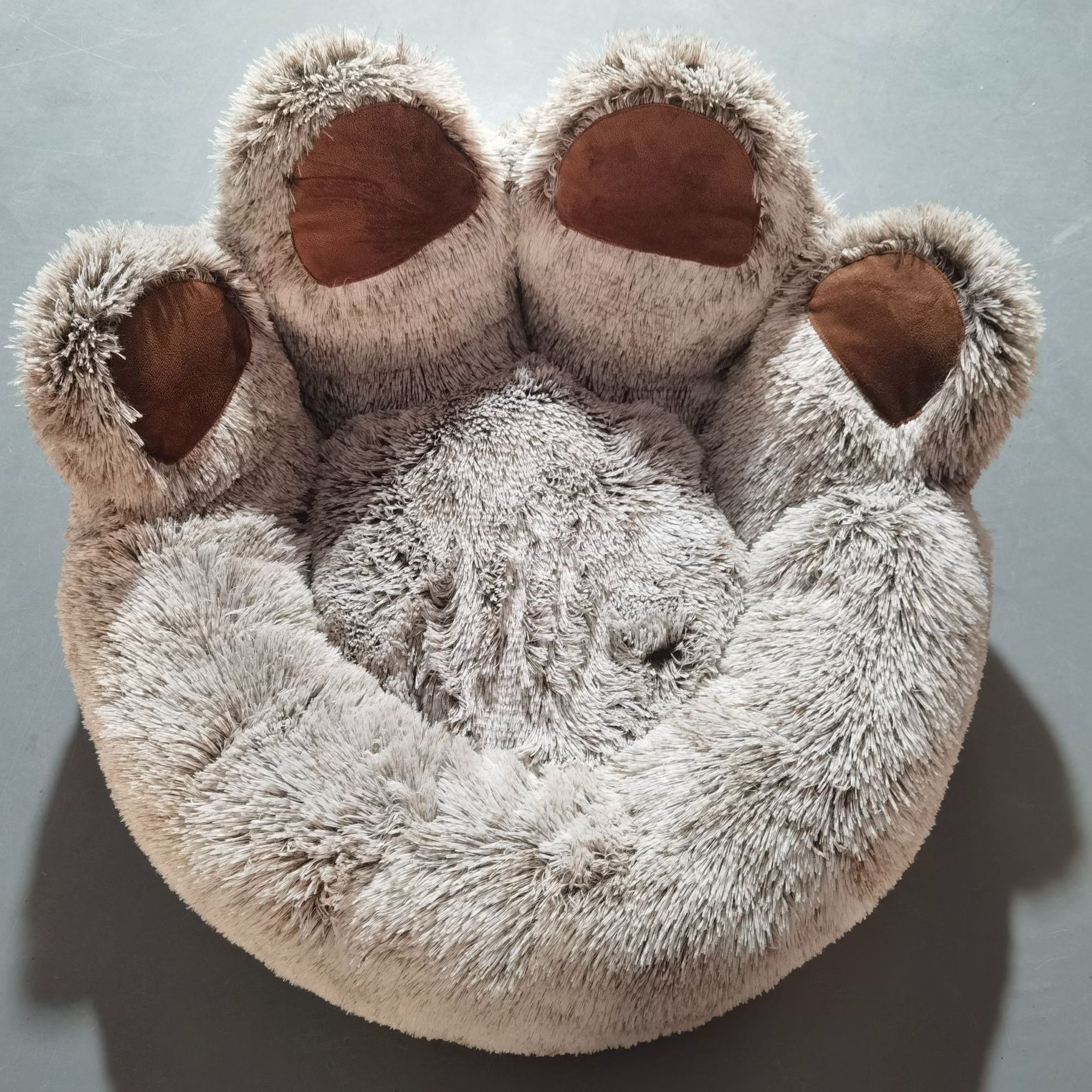
Stitching is where quality is won or lost in pet bed manufacturing. A beautiful fabric with poor stitching will fall apart within weeks of use by an active dog.
What to measure on samples:
- Stitch density: Standard seams: minimum 8 stitches per inch (SPI). Stress point seams (corners, handle attachments, zipper area): minimum 10-12 SPI. Measure with a stitch gauge — inexpensive and essential.
- Seam allowance consistency: Should be within 2 mm of specification throughout. Inconsistent seam allowances indicate operator skill problems or poor machine calibration.
- Thread tension: Pull the seam gently — upper and lower thread should lock in the center of the fabric layers. If the bobbin thread shows on top (or vice versa), the tension is wrong, and the seam will unravel under stress.
- Bartack reinforcement: Every stress point (handle attachment, strap connection, corner junction) should have a bartack — a dense cluster of 20-42 stitches that prevents the seam from pulling apart. Missing bartacks is a common cost-cutting shortcut.
- Thread type: Polyester thread (Tex 40 or Tex 60) for standard seams, bonded nylon (Tex 70-Tex 90) for high-stress areas. Cotton thread is never appropriate for pet beds — it absorbs moisture and weakens.
Checkpoint 5: Foam and Fill Verification
The fill material determines whether a pet bed maintains its shape and comfort over months of use or becomes a flat, lumpy disappointment.
Verification methods:
- Weigh the samples: Every sample you receive should be weighed on a kitchen scale. Request the factory's fill weight specification and check if the sample matches within 5%. A medium bolster bed should weigh 1.2-1.8 kg total; the fill alone is typically 0.4-0.8 kg.
- Cut open one sample: Yes, sacrifice one sample. Inspect the foam type, density, and distribution. Is the memory foam actually memory foam (press it — it should slowly return to shape over 3-5 seconds)? Is the PP cotton evenly distributed or clumped in corners?
- Compression recovery test: Press the bed flat with your hand for 30 seconds, then release. High-quality fill recovers to 90%+ of its original height within 10 seconds. Poor fill stays compressed or only recovers to 60-70%.
- Odor test: New foam has a slight chemical smell that should dissipate within 48 hours of unpackaging. Strong, persistent chemical odor after 72 hours indicates low-quality foam with high VOC content.
Checkpoint 6: Compliance and Certification Readiness
Different markets require different certifications. A quality manufacturer should know which certifications apply to your target market without you having to educate them.
| Market | Required/Expected Certifications | Cost to Obtain |
|---|---|---|
| USA | CPSIA (lead, phthalates), CA Prop 65, CPC (Children's Product Certificate — if marketed for puppies) | $500-$1,500 per product line |
| EU | REACH (chemical safety), OEKO-TEX 100 (textile safety), CE (for heated/electronic beds) | $800-$2,000 per product line |
| UK | UKCA marking (post-Brexit equivalent of CE), UK REACH | $600-$1,500 per product line |
| Australia | ACCC product safety standards, flammability testing | $400-$1,000 per product line |
| Factory-level | ISO 9001 (QMS), BSCI/SEDEX (social), ISO 14001 (environmental) | $3,000-$8,000 annually |
Pro tip: Ask the factory to share recent test reports from other clients (with proprietary information redacted). If they cannot produce any third-party test reports, they have likely never been audited — a significant risk for your brand.
Checkpoint 7: Sample Process and Revision Policy
How a factory handles sampling tells you everything about how they will handle production.
What to evaluate:
- Sample lead time: First sample: 5-7 business days is standard. Over 10 days suggests the factory is not prioritizing new business or has capacity issues.
- Sample cost: $15-$50 per sample is reasonable for pet beds. Free samples are unusual and may indicate desperation or the intent to upsell later. Refundable sample fees (credited against first order) are the ideal arrangement.
- Revision willingness: A good factory accepts 1-2 rounds of revisions without additional charges. Factories that resist revisions or charge for every change are difficult partners long-term.
- Sample accuracy: The sample should match the agreed specification within 2 cm on dimensions and 5% on fill weight. If the sample does not match the spec sheet, production will not either.
- Pre-production sample (PPS): Before bulk production starts, request a PPS made from the actual production materials and on the production sewing line. This is your final approval gate. Feitu Pet sends PPS photos and measurements for sign-off before every production run.
Checkpoint 8: Communication and Problem Resolution
The true test of a manufacturer is not how they perform when everything goes right — it is how they respond when something goes wrong.
What to evaluate before placing your order:
- Response time: Send an inquiry at different times of day. A professional factory responds within 12-24 hours during business days. Over 48 hours consistently = understaffed or disinterested.
- Technical competence: Ask detailed material questions (foam density, stitch type, fabric composition). If the sales contact cannot answer technical questions or repeatedly says "I will check with the factory," they are likely a trading company, not the factory.
- English proficiency: Does the factory have a dedicated English-speaking export team? Miscommunication causes more sourcing problems than any other factor.
- Problem-solving track record: Ask directly: "Tell me about a quality issue you had with a previous order and how you resolved it." A transparent factory will share a real example. A factory that claims to have never had a quality problem is either lying or has no quality monitoring system.
- Production updates: Professional manufacturers send proactive updates at key milestones: material sourcing complete, cutting started, sewing 50% done, QC passed, packed and ready to ship. If you have to chase them for updates, expect to chase them for everything.
Putting It All Together: Factory Evaluation Scorecard
Use this simple scorecard to compare factories side by side. Rate each checkpoint 1-5:
| Checkpoint | Weight | Factory A | Factory B | Factory C |
|---|---|---|---|---|
| 1. Scale & capacity match | 10% | -- | -- | -- |
| 2. In-house processes | 15% | -- | -- | -- |
| 3. Material transparency | 15% | -- | -- | -- |
| 4. Stitching quality | 15% | -- | -- | -- |
| 5. Foam/fill verification | 15% | -- | -- | -- |
| 6. Compliance readiness | 10% | -- | -- | -- |
| 7. Sample process | 10% | -- | -- | -- |
| 8. Communication | 10% | -- | -- | -- |
| Weighted Total | 100% | -- | -- | -- |
Score interpretation: 4.0+ = Strong candidate, proceed to sampling. 3.0-3.9 = Viable but with areas of concern, proceed with caution. Below 3.0 = Look elsewhere.
At Feitu Pet, we welcome factory evaluation from every new client. Our 6,000 sqm factory in Xuzhou, Jiangsu operates 60+ sewing machines across dedicated production lines for pet beds, dog car seats, and human dog beds. We provide live video factory tours, detailed material test reports, and pre-production samples for every order. Start your evaluation with a free quote and sample request.
Related reading: Wholesale Dog Beds from China: MOQ & Pricing | Top 10 Pet Bed Manufacturers in China